For most World Cup finals, there are two teams, two sets of tactics and two possible outcomes.
Not this one.
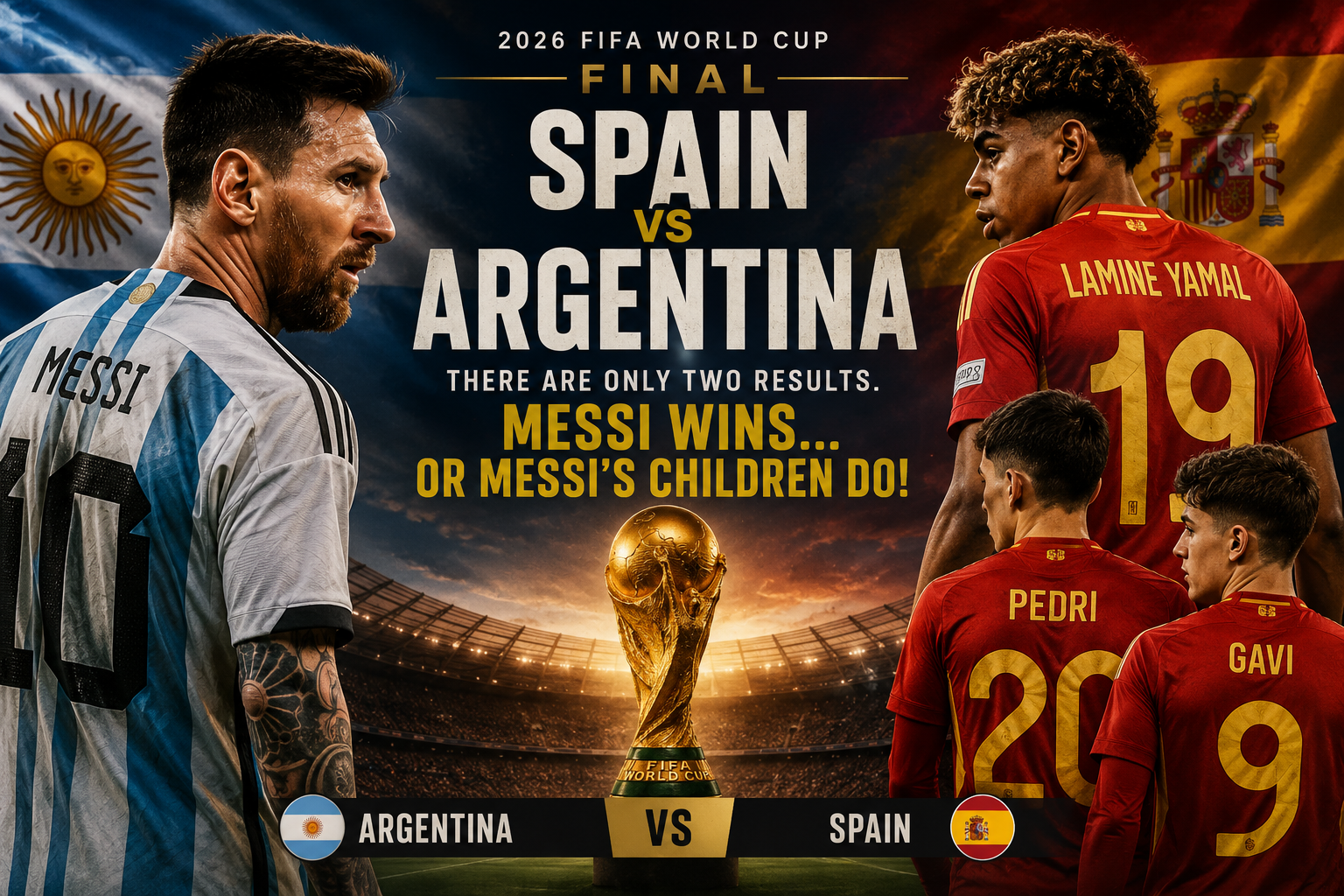
When Spain and Argentina walk onto the pitch for Sunday’s 2026 FIFA World Cup final, the storyline feels almost absurdly simple: either Lionel Messi lifts the trophy again, or Lionel Messi’s footballing children stop him.
That, perhaps, is the strangest and most captivating angle of a final that pits football’s past against its future.
Argentina arrive carrying the aura of a team determined to prolong a golden era. Messi, now in the twilight of a career that has already conquered every summit available, stands one victory away from ending his World Cup journey exactly where football romantics would want it to end — on top of the world.
But standing in his way is a Spain side that looks suspiciously like a tribute act to the man himself.
Lamine Yamal grew up idolising Messi. Pedri studied his movements. Gavi belongs to a generation that learned football through YouTube clips of the Argentine weaving through defenders in Barcelona colours. Even Spain’s attacking philosophy still bears traces of the footballing ecosystem Messi once dominated.
In many ways, Sunday’s final resembles a family reunion gone terribly wrong.
The father wants one last dance.
The children want the inheritance immediately.
Spain have been the tournament’s most complete side. They breezed through the knockout rounds, eliminated Portugal, edged Belgium and then dismantled France 2-0 in a semi-final performance that confirmed their status as genuine favourites.
Luis de la Fuente’s side possess youth, energy and fearlessness in abundance. They press relentlessly, move the ball with surgical precision and attack with the confidence of players who have never experienced football’s disappointments.
Argentina, meanwhile, have travelled a more dramatic path.
Victories over Egypt, Switzerland and England showcased the Albiceleste’s enduring ability to thrive under pressure. Their semi-final triumph over England was another reminder that tournament football often belongs to teams that know how to suffer.
And no team understands that better than Argentina.
The final also presents a fascinating clash of generations.
Spain represent what football is becoming.
Argentina represent what football has been.
Yamal, still a teenager, could become the youngest superstar ever to define a World Cup final. Messi, at the opposite end of the spectrum, could become the oldest iconic figure to shape one.
One player is building a legacy.
The other is protecting one.
The symbolism is impossible to ignore.
For nearly two decades, world football has revolved around Messi. Entire generations of elite players grew up watching him dominate club and international football. Now many of those same players are attempting to push him aside.
It is football’s version of succession.
The apprentice finally challenging the master.
The complication for Spain is that Messi has spent his entire career refusing to follow scripts written by others.
Every tournament seems to produce a moment when logic gives way to inevitability.
Argentina’s opponents know this.
Fans know this.
Perhaps even Spain know this.
Which is why Sunday’s final feels less like a conventional contest and more like a referendum on football’s timeline.
Can the future arrive before the past is ready to leave?
Can Yamal and company complete the transition of power?
Or will Messi summon one final masterpiece and remind the world why every generation still measures greatness against his name?
There may officially be two teams in the final.
But the narrative remains wonderfully uncomplicated.
There are only two results.
Messi wins.
Or Messi’s children do.